It was a true pleasure to attend the New Orford String Quartet's recital in Langley this evening at the Rose Gellert Hall. They played an amazing concert of Beethoven, R. Murray Schafer, and Johannes Brahms. The quartet, again, proved themselves to be one of North America's most formidable chamber music groups.
This first selection on the program was Ludwig Van Beethoven's last early quartet, opus 18, no. 6. The musicians played with fantastic accuracy and their sense of ensemble was fabulous. The fourth movement was particularly magnificent as this is where the audience could really observe how four people can create a conversation through music. It was also during this final movement of the Beethoven selection that the quartet particularly illustrated their ability to convey the nuances of dynamics and colour in this composer's work. Throughout all four movements, the audience was led on a journey through the different moods that Beethoven presents in this piece, all the while showing a fine degree of control. It was truly a unique and wonderfulexperience to hear R. Murray Schafer's String Quartet no. 1 played by the New Orford String Quartet. The playing was energetic throughout the piece. The quartet created a sense of excitement and even mystery during the performance of this work. There was intensity and enthusiasm which added to this performance. Brian Manker, the quartet's cellist, gave an excellent explanation of the composition before they performed it in order to prepare the audience for what they could expect to hear. I was very impressed to see that the quartet had chosen to include a contemporary, Canadian work on their program.
After the intermission, the quartet played ...wait for it, Johannes Brahms! Ah yes, glorious Brahms. They performed String Quartet opus 51, no. 2 in a minor. First of all, I will admit my bias. Anytime someone puts Brahms on their program, I'm already happy. The New Orford did NOT disappoint! The first movement was rich in tone and the sense of ensemble was again, superb.
The second movement was heartfelt and a moving interpretation of this gorgeous music. For me, the highlight of the Brahms performance was the third movement. The quartet's unison was incredible. Moreover, the sensitivity that they demonstrated during this section was impressive. In this third movement, Brahms writes more than just a simple minuet. The mood calls on the performer to play with great emotional depth. The New Orford Quartet did just that.
The quartet's performance of the fourth movement of Brahms' opus 51, no. 2 quartet had everything one could look for in a great finale. I really enjoyed the tempo that they chose because it gave a chance for the musicians to showcase their fabulous understanding of Brahms' phrasing.
This was a truly thrilling evening of chamber music. Canada is very fortunate indeed to have the New Orford String Quartet. They are a wonderful group of musicians who share their hearts and love of music warmly with each audience. Bravo!
Fall is one of my favourite seasons. As a Grade 4 French Immersion teacher, going back to school is always thrilling, but exhausting. This September and October have been busier than usual. Due to a series of circumstances, I found myself appointed artistic director of a brand new concert series in Vancouver. My initial thoughts upon accepting this post ranged from "I must be crazy because I'm a full-time teacher and how will I find the time to commit to this and my classroom?" to "this is very exciting and I can bring people together through music. Let's do this!" The first thing I did was find a person to partner up with on this venture. In Diana Chan (an oboe player in her senior year at UBC), I not only found an excellent business partner but a dear friend who is there for moral support as well.
Each day has brought a range of emotions. On certain days, generous fundraising comes in and I am encouraged that people believe in what we're doing here. Other days, I wonder if people are even noticing the events we're posting on social media. I wonder if people will actually buy tickets to our recitals that we're working hard to present. On those days, I have to remember that it's about the music - and even if that music reaches one audience member, that's enough.
I've lived in Vancouver for 6 years and have often felt that it is a lonely and isolating place. I see diversity all around me and am wanting to participate in cultural events but have found that the cost of living here prohibits having a high entertainment budget. As co-artistic director, I hope our concert series can address both the isolation of being in a city and the affordability and access to culture. By keeping the ticket prices low to our evening recitals, we hope that more people in Vancouver will be able to access classical music and that community can be fostered by people connecting at our concerts.
The other mandate that Müzewest Concerts has is to bring excellent classical music performances to local elementary public schools in which the student population could not otherwise afford to attend classical music concerts. We believe that classical music transforms the lives of the students who hear it and has a positive impact on their social, intellectual, and emotional development.
Much has been written on Stravinsky's "Rite of Spring" this year and how this amazing music literally shook the music world in Paris 100 years ago. I don't wish to repeat what has been said by music critics or commentators but I wish to show you what young students' perception of this amazing music is. Just look at the colours and subject matter! They get it.
There is such deep sadness in the top left figure - almost like a grieving parent. Meanwhile, I am struck by the peaceful expression of the young girl - even in what must be a horrific death.
Absolutely terrifying. Blood, words begging for help and the rejection of that plea for assistance.
The top middle figuring is so sadistic and menacing. The presence of ghosts is haunting.
The inclusion of the grieving mother is heart-wrenching. Again, we have an evil character who is perceived as a bigger size. The curves and lines bring a sense of chaos.
I absolutely adore the pop art approach to the sacrificed young girl. The artist told me that they hope the girl sacrificed is now an angel but still carries the marks of her death with her.
And here is one of the best recordings of Stravinsky's "Rite of Spring" out there.
This was my third visit to the Banff International String Quartet Competition (BISQC.) It is hosted in the most beautiful spot imaginable - the Banff Centre for Arts. Nestled in the majestic Canadian Rockies, this competition brings the world's top string quartets to play music for an adoring and discerning audience.
The Tunnel Mountain West loop - great for hiking!
There is a wide range of opinions on music competitions. Some people champion them as the only way for young classical artists and ensembles to get their careers off to a start. It is undeniable that the career support and recital engagements offered with most competitions can help springboard the career of a musician. The BISQC is no exception to this. The support offered to the winner is truly incredible and quartets that have won first place have certainly enjoyed success. You've surely heard of a little group called the St. Lawrence Quartet I'd imagine? Yep, they're past winners! This would certainly be placed in the "pros" column regarding music competitions.
Hoodoo Lookout Point over the Bow River
Another great feature of music competitions is that the musicians get to share the music so close to their hearts with an audience. Some members of the audience could be concert presenters or may be able to financially sponsor a recital for these ensembles or artists. In this way, it is beneficial for artists to participate in competitions. The simple fact of having that kind of exposure can mean that quartets or musicians are able to break into a new market.
Unfortunately, I witnessed firsthand the negative aspects of competition. Essentially, many aspects of the decisions are left entirely to chance and some of the decisions made by juries are simply unexplainable. If one is on the wrong side of these results, it can be completely discouraging. I found myself in the position of having to comfort a friend who was disappointed with their results in the BISQC. They truly did not understand how the jury could have made such decisions. With all of the effort that musicians put into when preparing for a competition, the question remains: is it worth it? If the decisions are subjective and slightly, dare I say it, arbitrary, why go to all that work?
Well, because between the good and the bad of music competitions, there is the beautiful. Now, I will preface this by saying that perhaps the Banff International String Quartet Competition is unique in this aspect. Nonetheless, I have to remark that what I saw was musicians bonding over what we all love - the music. The quartets, with very few exceptions, all got to know each other and some even developed close friendships. These relationships may not have formed without the competition. The collegiality and genuine warmth that the musicians showed each other was simply heartwarming and encouraging for me to witness.
Essentially, the Banff International String Quartet Competition brought together a community of wonderfully talented musicians who were able to bond over their deep love of chamber music. I could not have asked for a more inspiring weekend of music. As a musician, I am now motivated to practise my art more when I return home to Vancouver. Moreover, I am grateful for the new friends that I have made who share the same passion for the great art of music. The Banff International String Quartet Competition is a testament to the power that music has to build community and relationships. I am deeply sad to leave this magical place but I am grateful that this competition offers musicians a space in which to share their art with the public. What a special week it has been here in Banff!
I've been teaching music all summer. It's been fairly wonderful 87% of the time. The other 13% of the time it has been challenging and frustrating to say the least.
Mostly, I've been teaching young children using an Orff Schulwerk philosophy. Their average age is five, which means that they are completely open to new experiences on one hand but also come with a variety of skills and developmental levels. Our activities have ranged from dancing to music, creating beats with percussion instruments, and a LOT of music appreciation. Oh, and we have sung B-I-N-G-O at least 232 times in the last six weeks. That is not an exaggeration.
Some of the young children have been enthusiastic about trying to produce rhythms and dancing to music. Others have been totally reluctant. When I have done music appreciation activities and shared my heart regarding pieces of music that matter a lot to me, I have, on occasion, been met with blank stares. Many of the students simply considered music class as a time to be goofy, silly, and down right poorly behaved. That is a far cry from when I had piano lessons and was expected to sit respectfully and listen attentively. Nonetheless, I have had to adjust my expectations. What I wish to share today is about how teaching music, when you're in love with music, can require adjusting your expectations.
With the students at summer school, I've had to adjust my expectations about how they will respond to being asked to sing or play music. If someone asks me to sing, I will gladly smile and harmonize along. I will find meaning in the text and enjoy the melody. After trying countless ways of getting children enthused about singing, I've realized that it just isn't everyone's cup of tea. Due to anxiety or shyness, playing an instrument in front or even with a group may not be for every learner. I simply have to make each experience with music as enjoyable and authentic as possible.
Another way in which I have had to adjust my expectations is with my piano student. Her Royal Conservatory Grade 8 Piano exam is tomorrow. Frankly, she has not sufficiently prepared and I do not expect her to receive a very shining report. I would never personally entertain the thought of sitting for an exam with the level of preparation that she has done. This point is criticalas a music teacher. We are teaching music because we are head-over-heels in love with it and are passionate about the repertoire. I'm here to state that we are not the majority. We may be surrounded by other music enthusiasts, but that does NOT guarantee that our students will come to us with the same motivation.
So, this begs the question: how do we respond when a student is not as enthusiastic as we are? My piano student told me tonight that "she is not sure if she even likes music anymore." That statement, for me, is the key to how I approach teaching music. Nothing, and I mean nothing, is worth the student losing their love of music. There is no competition, exam, or performance that is worth risking a student losing their desire to create and enjoy music. If my piano student simply does not care about the mark she will receive, at some point I have to relinquish control of that. I would not make the choices that she does in terms of practice routines, but then again - I am not her. I can not reasonably expect her to be as in love with Chopin or Bach as I am. I have to realize that I am the outlier.
I am not suggesting that we simply allow our students to perform music as they wish and have no standards. The music that we love demands that we approach it with the utmost integrity and preparation. However, what I am arguing is that we can only do so much in our circle of responsibility and may just simply need to release the anxiety that we have over what kind of musician they become. Their passion or interest for it may simply not be motivating enough for them to make progress. In this case, we should strive to make lessons enjoyable, positive, encouraging, and honest. Allow students to express if they do not appreciate a particular piece.
Many of us have taught this type of music student - the one who is fed up with practising and really does not have that great of a passion for music. However, today, I also experienced the joy of teaching someone who is truly engaged with music. I am preparing another student for her Royal Conservatory History exam in December. Today, I got to teach her for nearly two hours on the life, music, and influence of Wolfgang Amadeus Mozart. Ok, stop right there.
I got to teach on two hours about a topic on which I'd love to speak all day. Oh, and I got paid while I was at it. Are you kidding me? They are paying me to discuss and share about my life's passion and love? That is what it is to teach music. We get to share one of our life's greatest loves. As I taught her about the operas Mozart composed, the life he led, and what influence his music had on Western culture following his death, I thought to myself: "I am the luckiest person alive." What a privilegeto teach music to others.
Why is teaching music a privilege? Simply put, it is a privilege and honour because we are sharing a deeper part of ourself. We are exposing students to the world of music in which they can fully encounter what it means to be human and experience a vast variety of emotions, colours, and moods.
So, the next time a student has not practised as much as necessary, or potentially bombs an exam, I will try to be grateful. At the end of the day, I've shared with them what I love and surely I can strive to find joy in that simple fact!
Beethoven Sonatas: Volume 1 (edited by Heinrich Schenker), Dover ($15)
Beethoven Sonatas: Volume 2 (edited by Bülow-Lebert), G. Schirmer ($20)
Both of these books are in MINT condition and have never been used.
The two Beethoven Sonata books I'm selling.
I'll throw in your choice of Schubert or Chopin if you purchase one of the Beethoven books! If you buy both Beethoven, you'll receive both Schubert and Chopin! :)
For the last few weeks, my piano student and I have been discussing her future in piano and whether or not she will continue after finishing her Grade 8 RCM (Royal Conservatory) exam. She has scheduled the exam for August. Last week, I had told her that she would likely regret quitting piano later in life. She is currently thirteen years old and has simply lost a lot of her motivation. Nonetheless, my student, who we will call Mary, recognizes that she can't predict how she will feel about piano in the future and needs to think long term.
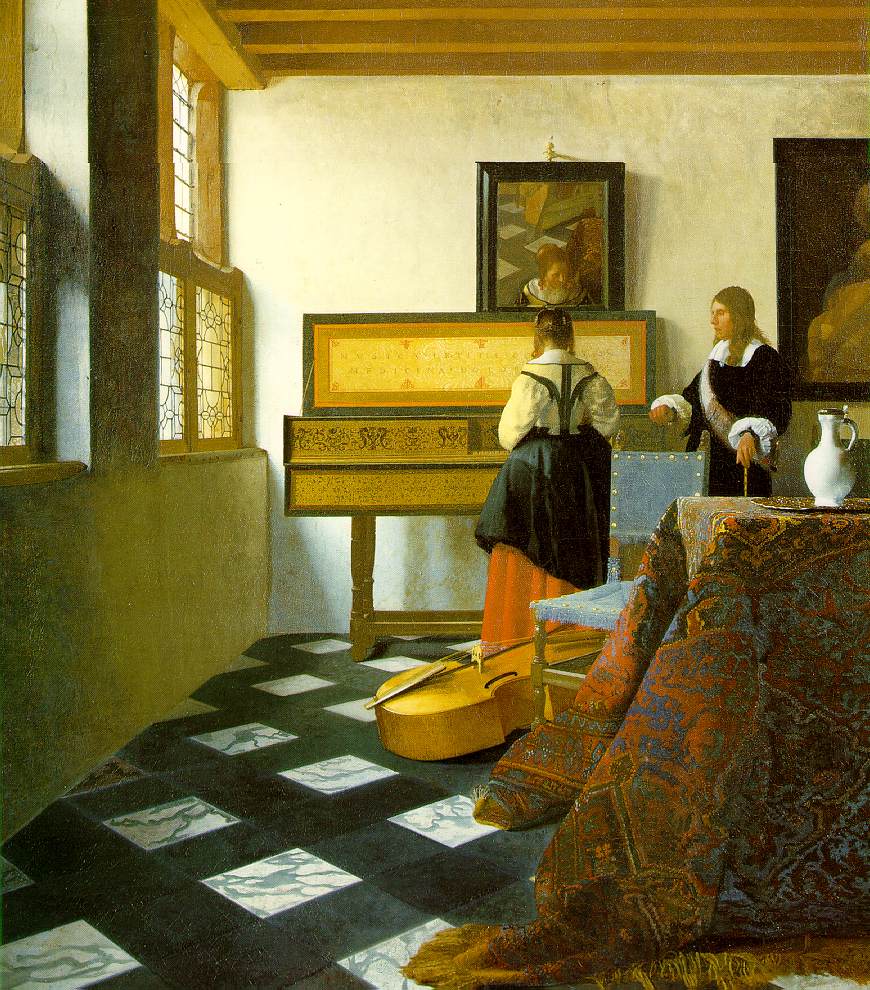
Jan Vermeer - "The Music Lesson"
Today, I asked her if she'd given her future in piano any more thought. In fact, she had. She says that piano has never really been enjoyable for her because she used to often cry while practising. I asked her what made her cry during her practice sessions. Mary replied that her father was always standing in the room waiting for her to make a mistake and then criticize her playing. In fact, he would yell at her. I instantly asked her if this still occurs. She said then the yelling has ceased in the last year. I was very relieved to hear that. Nonetheless, my student has extremely negative memories associated with practising the piano. She gets easily frustrated when she can not play accurately because there were emotional consequences from her father. There are a few important lessons to take from what happened today when I taught my student.
Firstly, we must teach students to practise wisely and in ways that can avoid frustration. Encourage students that practising three bars of music slowly and in detail is much more valuable than being overwhelmed by a whole sheet of notes and an entire piece. In particular, this is true of Bach. His contrapuntal music simply has a LOT OF NOTES! Keep it simple. Keep it focused. Have I ever mentioned practise slowly? You get the idea. Secondly, to the parents of children taking lessons: I have strong words. Music education is about fostering a love of music. It is NOT about winning competitions or receiving high marks on exams. Those things are not bad in and of themselves, but they are highly subjective and not often consistent. More important, is to have the student express their feelings as a human being through their chosen musical instrument. Music is, first and foremost, a way of sharing one's soul with an audience. Ask yourself, parents, what love of music is being fostered in your home is practice sessions are stressful, negative times which are marked by tears, yelling, or frustration?
Pierre-Auguste Renoir - "La leçon du piano"
I implore the parents of music students to praise their child's efforts, listen to them perform, and be realistic with their goals. The greatest tragedy will not be your child quitting piano, but abandoning a love of music.